
Laser hair removal
Long-term hair reduction with a triple-wavelength diode laser, suitable for every skin tone.
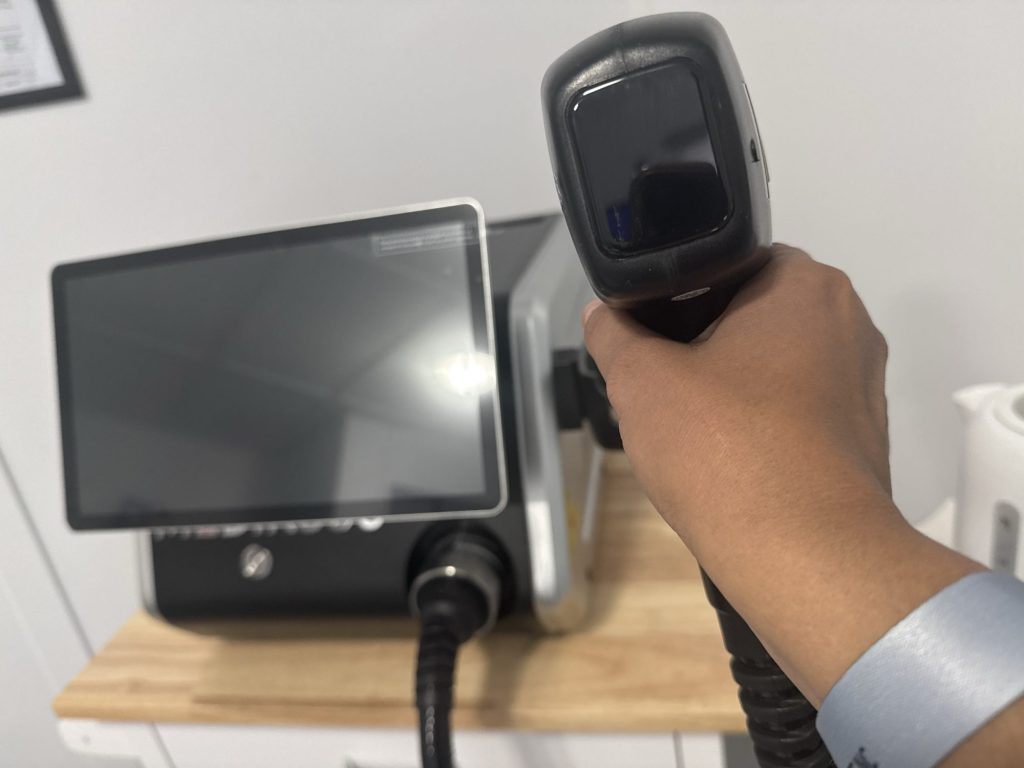
Laser hair removal reduces hair growth long-term by targeting the root. A beam of light is absorbed by melanin — the dark pigment in the hair — and converted into heat. That heat travels down the hair to the follicle and damages it, so it can no longer produce a new hair. The surrounding skin, far less pigmented, doesn’t absorb that energy: this is what makes the treatment both precise and comfortable.
The technology: three wavelengths
The clinic is equipped with a Health Canada licensed diode laser that emits three wavelengths. Each one reaches the hair at a different depth and suits a different skin and hair profile. It is this combination that makes it possible to treat every skin tone.
755 nm
The most readily absorbed by melanin. It effectively targets fine, lightly pigmented hair on light to medium skin.
808 nm
The reference wavelength in hair removal. It combines strong absorption with enough penetration to reach the bulb: this is the one doing most of the work on most areas.
1064 nm
The deepest-reaching, and the least absorbed by the melanin in the epidermis. This is what makes it possible to treat darker skin safely and to reach the deepest, coarsest hair.
Settings are never left to chance: they are determined at the consultation, after assessing your skin phototype and hair type, then adjusted from one session to the next according to how you respond.
For every skin type, and for everyone
With its three wavelengths, the device covers the full range of phototypes, from the lightest to the deepest skin tones. Darker skin — long excluded from laser hair removal — is treated with the 1064 nm wavelength, which passes through the epidermis without depositing its heat there.
Treatments are for women and men alike. Only the most requested areas differ from one clientele to the other.
The one limitation has to do with hair colour, not skin colour: white, grey, red or very blond hair doesn’t hold enough pigment to absorb the light. It won’t respond to treatment, and I would rather tell you that beforehand than after.
The benefits
No more shaving every morning
No daily razor, no stubble by the end of the day, no waxing appointment to rebook every four weeks.
Fewer ingrown hairs
Waxing and tweezing pull the hair out and let it grow back under the skin. The laser destroys the follicle, so the hair doesn’t come back to grow inward.
Smoother, clearer skin
No more razor burn, no more small red bumps, and no more bluish shadow lingering under the skin on underarms and bikini.
Everyday convenience
Sports, the pool, a last-minute night out: nothing to plan the evening before.
Time and money back
One series of sessions replaces years of razors, wax and appointments.
Results that last
Hair thins out session after session, and what grows back is finer and lighter. An occasional maintenance session is enough after that.
How a session unfolds
You settle in comfortably and your eyes are protected with goggles matched to the wavelength in use. The handpiece, fitted with a chilled tip, then glides over the area being treated.
Most clients describe the sensation as a small elastic band snapping against the skin. Active cooling at the tip makes the pass noticeably more comfortable and protects the epidermis.
It’s quick: an upper lip takes about fifteen minutes, underarms about twenty, full legs about thirty. You leave right afterwards.
Why several sessions are needed
Hair grows in cycles, and the laser only destroys hair in its active growth phase. At any given moment, only a portion of the hair in an area is in that phase — 65 to 70% on the face, but only 10 to 20% on the legs. Each session catches a new wave.
The interval follows the hair cycle: 4 to 6 weeks on the face, 6 to 8 weeks for underarms and bikini, 8 to 10 weeks for legs.
Areas treated
Face and precision areas
- Upper lip
- Chin
- Cheeks and sideburns
- Beard line
- Nape
- Neck
- Ears
- Brows
Body
- Underarms
- Arms and forearms
- Hands and fingers
- Chest
- Abdomen
- Back
- Lower back
- Shoulders
Bikini and legs
- Bikini line
- Brazilian
- Full bikini
- Buttocks
- Thighs
- Full legs
- Feet and toes
Results
Growth slows from the very first session. Over the following one to three weeks, the treated hairs are shed naturally: it often looks like regrowth, when in fact the hair is falling out.
The reduction becomes clearly visible after three or four sessions. Plan on 6 to 8 sessions to clear an area, followed by occasional maintenance. Whatever grows back in the meantime is finer, lighter and sparser.
Recovery
There is no downtime. The area may stay pink and slightly swollen around the follicles for a few hours, sometimes up to 48 hours — a sign the treatment took well. You resume your activities immediately, simply avoiding direct sun, hot baths, saunas and intense workouts for 24 to 48 hours.
More information at your consultation
Every first session is preceded by an in-clinic consultation. We assess your skin and hair, determine your phototype, perform a patch test, choose the areas and map out your session plan with the right intervals.
It is also the moment to ask anything you’d like: what it feels like, how many sessions, pricing, medical history and current medications. Every plan is built individually — which is precisely why this meeting matters.
Results vary from one person to another depending on the area, hair type, skin colour and hormonal profile. Laser treatment provides long-term hair reduction, not permanent and complete removal of hair.


